AI is creating an interesting contradiction in software engineering that I don't think we talk about enough.
We're increasingly asking engineers to use AI to move faster. Not 10% faster — in some cases, dramatically faster. An engineer who previously had the capacity to implement a few meaningful changes may now be able to research, prototype, implement, refactor, and iterate across significantly more work in the same amount of time.
That's incredible. But there's a systems problem hiding underneath that productivity gain.
If engineering throughput increases 5–10x, what else has to change?
The safeguards didn't get the memo
Code review doesn't automatically become 10x faster. QA doesn't automatically gain 10x the capacity. Manual regression testing doesn't scale 10x. Observability doesn't magically become 10x better.
And an engineer producing significantly more changes is naturally interacting with a much larger surface area of the product. More files touched, more components affected, more deployment paths exercised. The blast radius of a single engineer's week has grown enormously.
Some rough math on incidents
Consider a simplified model:
Real engineering obviously isn't this mathematically clean. Defect rates aren't constant — rushed changes, unfamiliar surface areas, and thin review coverage can genuinely raise them. But the principle matters: more incidents and worse engineering quality aren't necessarily the same thing when throughput changes dramatically.
If your incident dashboard is getting busier while your per-PR quality looks the same, the question worth asking is whether your safeguards are measuring a world that no longer exists.
Where the "10x engineer" conversation needs to go
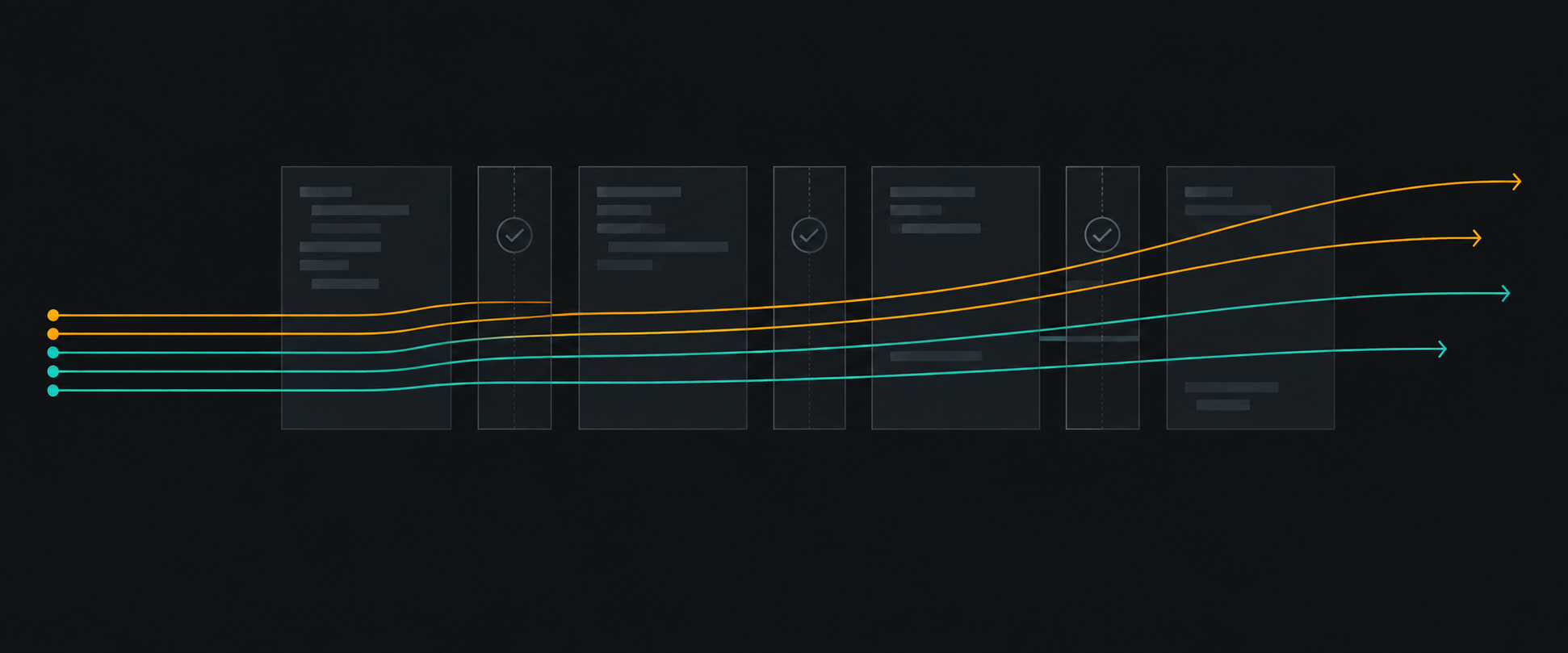
We've dramatically accelerated implementation while many safeguards still operate at the old speed. PRs still require a human reviewer with finite attention. QA may still be largely manual. Acceptance criteria can still be ambiguous. Regression testing, observability, and deployment processes still have finite capacity.
If we want engineers operating at AI speed, those systems need to evolve too. Concretely, that means:
| Safeguard | What "scaling it" looks like |
|---|---|
| Automated testing | Coverage that runs on every change, not sampled manually |
| Visual regression | Baseline screenshots catching unintended UI changes automatically |
| Deployment safety | Preview environments, feature flags, staged rollouts as defaults |
| Observability | Alerts and dashboards that notice regressions before users report them |
| Acceptance criteria | Written precisely enough that an agent can verify them |
| Review process | Reviewers spend attention on risk, not on formatting and typos |
| Validation | AI-assisted checking alongside AI-assisted implementation |
That last row is the one I find most interesting. We've built machines that write software; we now need machines that help us trust software.
This is not an argument for lower standards
It's the opposite.
AI isn't just changing how quickly we write software. It's changing the scale at which engineers can operate. The next evolution of AI-assisted development shouldn't just be generating more code — it should be building engineering systems capable of safely handling the increased throughput AI makes possible.
What I'd actually do this quarter
- Measure review latency. If AI speedups are piling up unreviewed PRs, your bottleneck is now the review queue. Track it.
- Automate the checks you repeat. Anything a reviewer verifies by hand more than twice a week is a candidate for a test, a lint rule, or a CI check.
- Add visual regression coverage to your most-shared components. They have the largest blast radius per change.
- Make acceptance criteria verifiable. "The form submits" is ambiguous. "Submitting with an empty email shows the inline error and does not call the API" is a test.
- Watch incidents per change, not just incidents. Normalize your incident metrics against throughput so a quality drop and a volume surge don't look identical.
10x engineering isn't just about making the engineer 10x faster. The system around them has to evolve too.