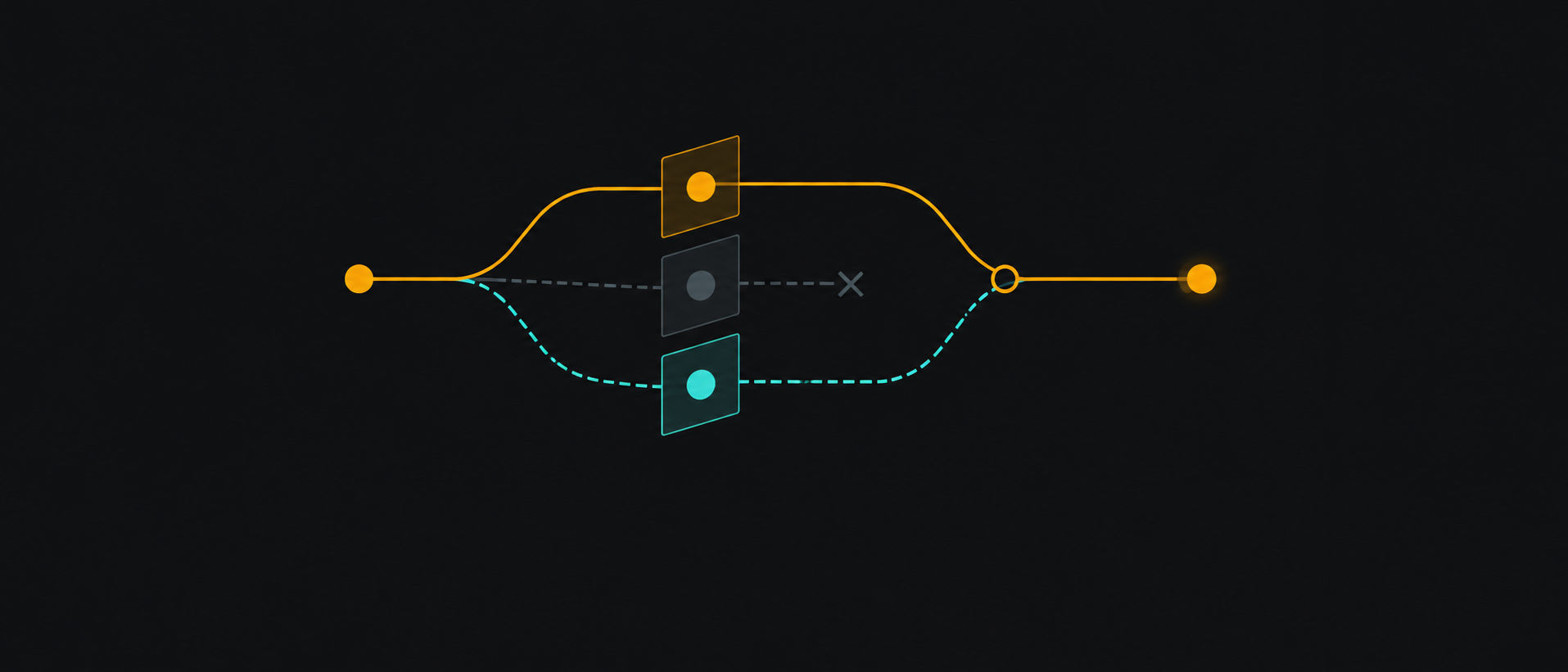
A feature flag can make a risky release easier to control. It can also leave another branch of behavior for every developer to understand, test, and eventually remove.
I learned to treat flags as architecture during a commerce project where checkout had historically required an account. The change was to let a customer complete a purchase as a guest, while keeping account creation optional. That sounds like a presentation choice until it touches identity, order ownership, payment boundaries, analytics, and the many places an existing customer may return to.
The project used PostHog as release and experiment tooling. That is the extent of the claim here: a tool in the workflow, not evidence of a particular outcome. I’m keeping the project and people anonymous, and I’m not attaching invented conversion numbers or a victory story to the change.
A guest checkout change is not a small toggle
The visible question was whether to show an account prompt. The architectural question was what the system meant by a guest order, and which capabilities were available before and after authentication.
The flag could decide whether a new checkout path was exposed to a particular audience. It could not be the security boundary. A browser-side value is mutable; the server still had to validate every request, authorize access to an order, and apply the same payment and data-protection rules regardless of what the interface displayed. Hiding an account-only action is useful interface behavior, not authorization. Frontend authorization is not security is the same boundary in a different feature.
This distinction changes how the work is divided. The flag selects a product experience. Domain rules define what a guest can do. Server-side checks decide what a requester is allowed to do. Analytics can describe exposure or behavior, but it does not make those rules true.
A rollout is not an experiment
A rollout answers: who can use this implementation, and how gradually do we expose it? The criteria might be an internal audience, a defined cohort, or a staged release. Its job is operational control and risk containment.
An experiment answers a different question: what comparison and measurement would support a product decision? That requires a defined hypothesis, a consistent assignment rule, a specified outcome, and a plan for interpreting the result. Merely putting a flag in an experimentation platform does not turn a rollout into a valid A/B test.
Mixing the two can create misleading comparisons. If the assignment changes between requests, a person can see inconsistent experiences. If several flags affect the same journey, the observed group may not represent the intended treatment. If the outcome was chosen after looking at the data, the result is not the pre-defined test the team thought it was running.
For checkout, consistency matters at the journey level: a person should not enter one path on the cart and unexpectedly switch paths midway through payment. The implementation needs a stable assignment strategy appropriate to the product, and the server must still enforce invariants independent of assignment. PostHog can help operate flags or experiments; the team still has to define the question, exposure, and measurement correctly.
Every branch expands the test surface
A flag adds more than “on” and “off” in isolation. There may be an existing-customer path, a guest path, a returning guest, a signed-in customer, a failed payment, or another active flag that changes the same page. The useful test matrix follows meaningful combinations, not every theoretical permutation.
For this journey, I would make the contract explicit and cover at least:
- Flag disabled: the established sign-in-required experience remains intact.
- Flag enabled: a guest can complete the intended checkout path without being forced to register.
- Returning customer: sign-in remains available and does not become a dead end.
- Boundary failures: invalid or expired state, rejected payment, and server authorization failures remain handled safely.
- Interactions: any other flag that changes cart, identity, or checkout behavior is tested in the combinations the team intends to support.
- End-to-end paths: guest and returning-customer journeys work across the actual checkout transitions, not only in an isolated component.
A test for each branch is not enough if it never checks that switching branches preserves shared invariants. Orders must remain associated with the correct identity model; protected data remains protected; and failure paths stay understandable. For broader boundary questions, the frontend architecture review provides a useful way to inspect data flow and ownership before implementation.
Flags create an ownership and cleanup obligation
A flag that ships without an owner becomes ambient complexity. Before introduction, name the flag for the capability or decision it controls, document the intended audience and fallback, identify the accountable owner, and record what evidence or date will trigger a decision. Avoid names that encode a temporary person, branch, or sprint.
The lifecycle should be deliberate:
- Define the behavior and the reason a flag is needed. Decide whether it is rollout control, an experiment, or a long-lived operational setting.
- Specify the default and failure behavior. A flag service being unavailable should not silently weaken server authorization or corrupt checkout state.
- Identify the affected UI, API, data, and analytics boundaries. Keep the enforcement rules on the server.
- Write the test matrix for both paths and meaningful interactions before widening exposure.
- Assign an owner, review date, and removal condition when creating the flag.
- Observe the staged rollout against the criteria chosen in advance; pause or revert when a guardrail is breached.
- Once the decision is made, remove the obsolete branch and tests that exist only for it, or intentionally convert the setting into a permanent product capability with an explicit owner and contract.
“Temporary” is not a cleanup plan. If the flag remains, the team should be able to explain why it is still a supported configuration rather than a forgotten release switch.
A practical flag lifecycle checklist
Before adding a flag, ask:
- Is this for gradual exposure, a valid experiment, or durable configuration?
- What behavior changes, and what invariants do not?
- Which server-side checks remain authoritative regardless of client state?
- Who owns the flag, its rollout, and its eventual removal?
- What default applies if evaluation is missing, stale, or unavailable?
- Which on/off paths, interacting flags, and end-to-end journeys belong in the test matrix?
- What pre-declared observations allow us to continue, pause, or retire it?
- When will we remove the branch, or document why the setting is permanent?
Then review the implementation as a system: acceptance criteria, visual regression checks, staged validation, and rollback behavior still matter alongside the flag. A staged switch is a control, not proof that the change is correct. Verification should be proportional to the risk of the user journey; a green test suite is not a ship decision.
Feature flags are useful precisely because they let teams change exposure without pretending the underlying change is small. Treat each one as a temporary architectural branch with explicit ownership, stable behavior, and a removal decision. The toggle is the beginning of that design, not the whole design.